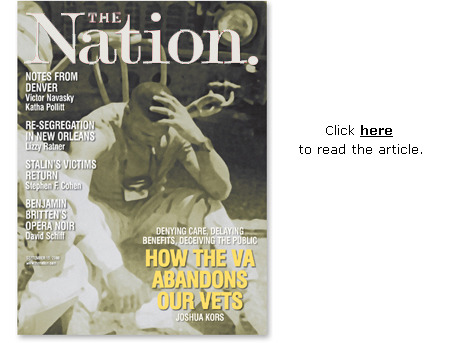




 |
|

In 2003, while studying at Columbia Journalism School, I produced an article on epilepsy spotlighting my struggles with the condition — and the groundbreaking treatment that helped me get well.
In 2021, at last, I've transformed my reporting into a brief video for patients and families struggling with epilepsy.
The video, "Stopping Seizures Before They Occur," explores innovative research conducted by psychologist Donna Andrews and neurologist Joel Reiter and lays out the techniques they developed that changed my life.

In March 2018 I had the unique opportunity to conduct an on-stage interview with Paul Rieckhoff, founder of Iraq and Afghanistan Veterans of America (IAVA), one of the nation's most prominent veterans organizations.
Rieckhoff and I both attended Amherst College, and both of us ended up in New York, working with veterans. But our paths from Point A to Point B were remarkably different. In a frank, thoughtful exchange, Rieckhoff reflected on his time at Amherst and his service in Iraq as a First Lieutenant in the U.S. Army.
The event featured an introduction from actor, activist and fellow Amherst alum Jeffrey Wright, star of "The Hunger Games" and HBO's "Westworld."

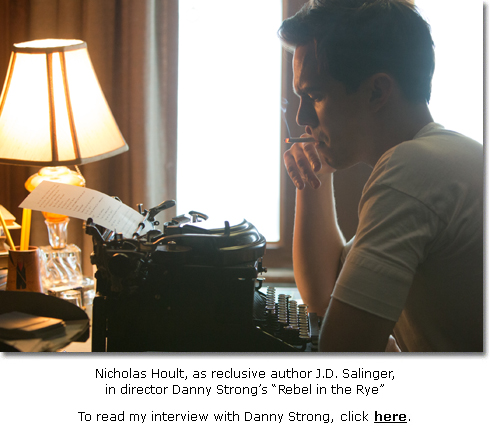
If you love "Catcher in the Rye" and are intrigued by J.D. Salinger, you should recognize writer/director Danny Strong as a kindred spirit.
Strong's Salinger biopic "Rebel in the Rye" premiered in September 2017 and was mercilessly savaged by critics, many of whom appeared hungry for a film version of "Catcher." As Strong explains in our HuffPost Q&A, the filmmaker wanted "Rebel" to be something completely different: an intimate look at Salinger the soldier. The film traces the author's pre-"Catcher" years and the way in which the trauma he suffered during World War II fueled the masterpiece that he scribbled into his notepad during his deployment.

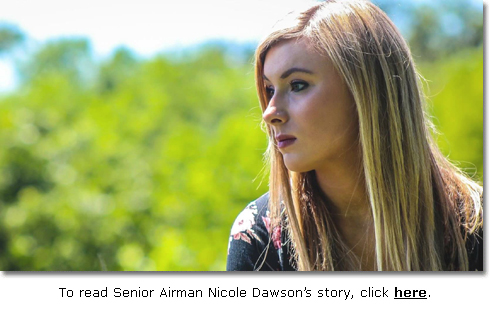
I've spent the last decade telling the stories of soldiers who have served our country, then been denied benefits and proper medical care.
That's what happened to Senior Airman Nicole Dawson. But when Nicole came to me and asked me to tell her story, I told her "No." Instead, I offered her something different: the chance to tell her own story, here, in my HuffPost column.
Recently I dropped by KGO to discuss veterans' issues with Ronn Owens, San Francisco's most prominent talk radio host.
This was my third time in-studio with the Hall of Fame broadcaster, and it gave us a chance to explore a wide range of issues facing our veterans, from the personality disorder scandal to reclaimed enlistment bonuses to MST (Military Sexual Trauma), the Pentagon's euphemistic acronym for rape and sexual assault.

A few days after our in-studio interview Owens' producer called and asked me to return to air to discuss a breaking scandal. In our recent interview Owens and I had discussed how thousands of soldiers discharged from the Army with "personality disorder" were forced to return a portion of their enlistment bonuses because they were too wounded to complete their contracts.

Now the Los Angeles Times had exposed a similar scheme by the California National Guard, which had pressed thousands of soldiers to return their enlistment bonuses a decade after going to war.
The media backlash proved remarkably effective. Four days after the Times story ran, two days after Owens and I took to the air, Secretary of Defense Ash Carter halted the Guard's program to reclaim soldiers' bonuses.
 In October 2016 I delivered a speech at U.C. Berkeley, part of the university's prestigious speaker series, The Berkeley Forum. In October 2016 I delivered a speech at U.C. Berkeley, part of the university's prestigious speaker series, The Berkeley Forum.
My talk featured extended clips from my military reporting, followed by an onstage interview and Q&A with the audience.
Video of the event will be posted here soon.
Soon after I began reporting on the military, I uncovered something quite disturbing: that thousands of our wounded soldiers are being discharged from the military not for their injuries but for "personality disorder." By discharging them with this unusual condition, the military can deny wounded soldiers a wide range of disability benefits, saving the military billions of dollars.
How did I uncover this scandal — and what can you do to help stop these fraudulent discharges?
In November, I addressed these questions in a TED talk at TEDxVanderbiltUniversity.

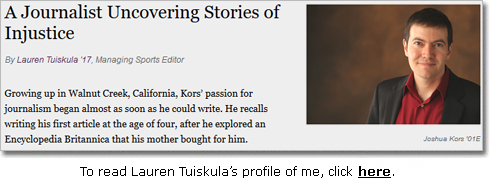
Seven and a half years after reporter Theresa Harrington wrote a beautiful profile of me in my hometown newspaper, the Contra Costa Times, I was contacted by a second reporter, Lauren Tuiskula, a current student at my alma mater, Amherst College.
Published shortly after I won the George Polk Award, Harrington's piece was essentially a "Local Boy Makes Good" story. With my TEDx talk coming up in a few weeks, Tuiskula wanted to write a similar piece for the Amherst student newspaper, essentially an "Amherst Grad Makes Good" story. Tuiskula and I had quite a wide-ranging interview. She also spoke with Professor Ilan Stavans, one of my mentors at Amherst.
The result was less of a profile and more of an epic, a truly thoughtful tribute tracing several decades of my reporting.
On Veterans Day — with my TEDx talk just four days away — I received a phone call from Ian Masters. Masters is a respected expert in foreign policy and host of a popular radio program, "Background Briefing," on KPFK in Los Angeles.
He asked about my upcoming talk and wanted an update on the personality disorder scandal: How many wounded soldiers have now been denied disability benefits due to these "personality disorder" discharges? And what impact might my TEDx talk have on the ongoing scandal?
Our lively conversation continued on air, as we discussed the high-stakes battle to halt personality disorder discharges and why Sunday's TEDx talk could prove a major turning point.

I'm delighted to announce that I have been selected to speak at the upcoming TEDx conference in Nashville.
The conference will be held November 15, 2015, on the Vanderbilt University campus. It will feature talks about archaeology, music therapy, sex, health, and career advancement.
I will be sharing my reporting on the veterans' benefits scandal and talking about what we can do to assist our soldiers and their families. For more info about the conference, including how to get tickets, click here.

Did you know that I used to report for a kids’ science magazine? It’s true!
Between 2007 and 2012, I produced 17 pieces for Current Science. My reporting ran the gamut, including everything from fracking and paraplegic scuba diving to the chemistry of perfumes and the thermodynamics of wildfires.
I’ve created a new section for my science articles. Check them out here.

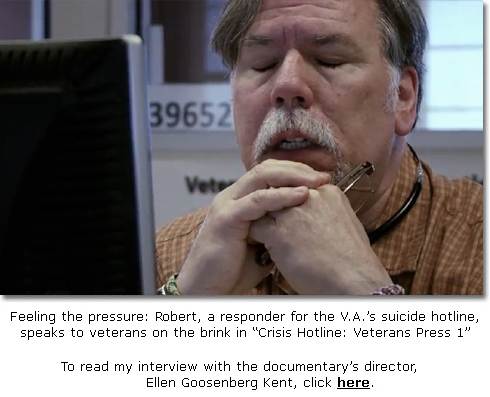
I watched the Academy Awards this year and was moved by the words of Ellen Goosenberg Kent, who took the stage to accept an Oscar for her documentary “Crisis Hotline: Veterans Press 1.” The film takes viewers inside the Veterans Crisis Line, a suicide hotline established in 2007 by the Department of Veterans Affairs. Goosenberg Kent and her crew embedded themselves in the call center for over three months, watching as trained responders answered calls from thousands of veterans on the brink, many of them armed and ready to act.
After hearing the director’s speech, I was determined to watch her film. After watching the film—an astounding blend of suspense and empathy—I was determined to interview her. The Huffington Post published our Q&A on Independence Day. Goosenberg Kent discussed the film, the V.A.’s Crisis Line, and provided some excellent insight into how each of us can truly honor the troops.

In addition to speaking with veterans in crisis, responders at the Veterans Crisis Line connect callers with organizations that provide counseling and other resources. Here is a list of organizations recommended by Crisis Line responders.
At the bottom of the list, under
"Additional Resources," you'll find a link to a second list that I compiled featuring top-notch, nonprofit organizations that provide a wide range of services, including assistance in acquiring V.A. benefits, post-military job training, legal help, and counseling for PTSD and depression.

What
do you know about Iraq veterans and uranium poisoning? I hadn't heard a thing about it until I saw "Trooper," a heart-wrenching new film directed by and starring Christopher Martini.
Martini plays Murphy O'Shea, an Army specialist who returns home from Iraq intent on leaving the war behind him. Instead, he begins feeling haunted by his battlefield memories and plagued by an odd illness. A doctor at the local V.A. tells him it's "just some posttraumatic stress." But the persistent headaches, chronic diarrhea, and some bizarre burns on his shoulder suggest something far worse: poisoning from depleted uranium.
Martini spoke with me about
his remarkable film and why he was intent on spotlighting a devastating illness few outside of the military have even heard of.
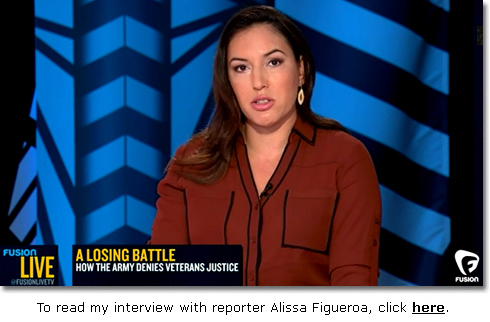
A year ago I got a call from Alissa Figueroa, an investigative reporter for Fusion (an ABC News/Univision joint venture). Figueroa expressed interest in my reporting on the personality disorder scandal. We spoke for several hours. I shared everything I had learned in my seven years covering the story, along with names and numbers of key contacts. After that, I never heard from her again.
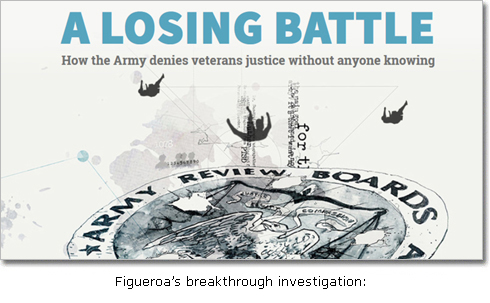
Until a few weeks ago, when she emailed to inform me that she had just spent the entire year following up on my reporting. The result: a stunning four-part investigation of the Army Board for Correction of Military Records, which is designed to assist soldiers who had been wounded during war, but discharged with a pre-existing condition instead, then denied benefits. Thousands of wounded soldiers have applied to the Board to get their cases fixed. But as Figueroa found, zero have succeeded.
Figueroa spoke with me about her breakthrough investigation and its ramifications.
   
Law school can overwhelm. At the end of each week, when the lectures begin to blur, I step away from it all and stroll down to Nashville's honky tonks, where a rotating circuit of singers address rowdy crowds of the tattooed and inebriated, laying a southern twang on timeless tales of heartache and hope.
No one does it better than singer Holland Marie. In my first year at Vanderbilt, I came to see Holland perform four times. The North Carolina native made an art of strutting the stage in her black pleather pants, whipping her long, brown hair and belting familiar lyrics with uncommon honesty. In her just-released debut album, Holland does something even more captivating: slows down her pace and tells raw, autobiographical stories, each with the hummable hooks that have won her a legion of fans in Music City. Holland spoke with me about her songwriting, her new album and the prospect of national recognition.

When I was in college, I spent a summer working for documentary filmmaker Mark Mori. Mori was a skilled political firebrand. He earned an Oscar nomination for his investigation of a nuclear bomb factory in South Carolina and won an Emmy for his reporting on the Kent State massacre. But his true magnum opus was his documentary on Bettie Page, the 1950's pin-up icon, whose trademark black bangs and daring S&M photography sparked Congressional hearings on obscenity and shifted America's sexual revolution into high gear.
Mori spoke with me about his film, which was just released after 16 years in the making. The film, narrated by Page herself, traces the model's extraordinary life: from the orphanage to pin-up stardom, before legal troubles and mental illness pushed her from the public spotlight.

In August I changed career paths. I moved from New York to Nashville, set aside my work as an investigative reporter, and began law school at Vanderbilt University. Friends and family wanted to know why. This piece, written for Amherst Magazine, explains. It traces my unexpected journey from reporter to Congressional witness to veterans' advocate and now to law student in Tennessee, the first step towards representing wounded soldiers in court.
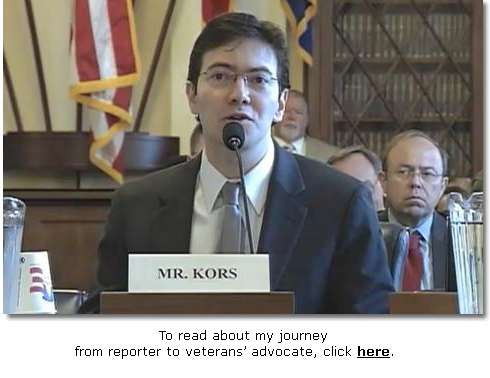
The statistics are repulsive: Since 2006, more than 95,000 soldiers have been sexually assaulted while serving in the military. Approximately 25 percent of those victims didn't report being raped because the person to report to was the rapist.
Today's soldiers are fighting to survive in a military that hides its sins behind crafty, euphemistic acronyms. Just as shell shock morphed into "PTSD," Pentagon officials are reframing being raped as "experiencing MST," or Military Sexual Trauma. My latest op-ed is a clarion call to military families and concerned citizens to do something simple: support our soldiers by defeating that euphemism and its insidious acronym. By refusing to use them in print, on air and in conversation, we can shift the focus back to where it needs to be: to the rape, sexual assault and sexual harassment of half a million soldiers.

My op-ed on "Military Sexual Trauma" clearly struck a chord. It was soon shared, tweeted, liked, emailed and commented on hundreds of times. Most readers embraced my call to banish that euphemism from the national discussion of the military's rape epidemic.
Two days after my piece ran, the movement to defeat MST jumped to the airwaves. I was invited to appear on "The Jack Riccardi Show," one of Texas' top political talk shows. Riccardi and I discussed how the Pentagon is using euphemisms and acronyms to confuse the public, soften its image and silence thousands of brutalized soldiers.

When Congress' 2010 investigation of "personality disorder" discharges ended without action, most people in Washington considered the issue dead. Congressman Tim Walz was not one of them.
A few weeks ago Walz, a former command sergeant major and the highest-ranking enlisted soldier ever to serve in Congress, put forward a bill that would give soldiers discharged with personality disorder a second shot at benefits. Walz spoke with me about his bill, the Servicemember Mental Health Review Act, and the hope it offers to wounded soldiers who are suffering without disability and medical benefits.

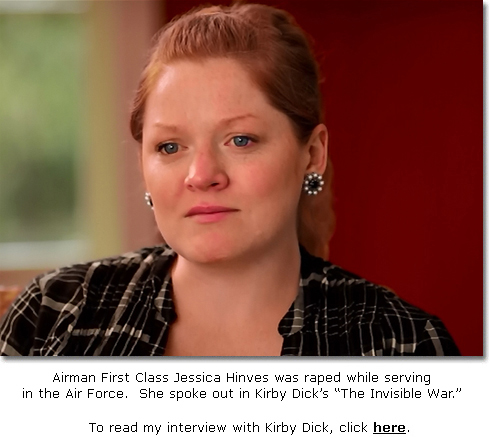
In June 2006 I wrote a profile of Abbie Pickett, an Iraq War vet who was raped while serving in the military. Pickett's story was horrifying, but I never realized how common it was until watching Kirby Dick's stunning documentary "The Invisible War."
The acclaimed director shows how sexual assault is an epidemic in the U.S. military. More than 20 percent of female soldiers are raped during their service. Dick's film spotlights the military's aggressive efforts to protect the rapists in its ranks and punish victims who decide to speak out. "The Invisible War" has now been nominated for an Oscar for Best Documentary. Dick spoke with me about the film's success and what each of us can do to make sure these victims are no longer invisible.
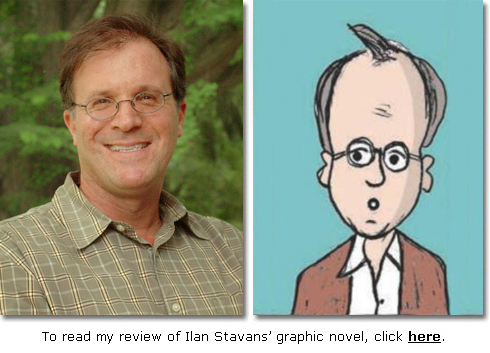
A few weeks ago my alma mater, Amherst College, approached me and asked if I would write a book review for the alumni magazine. The book: "El Iluminado," a graphic novel by Ilan Stavans and illustrator Steve Sheinkin.
An acclaimed novelist and literary critic, Stavans is an Amherst professor of Latino culture and has remained a mentor and friend since my graduation in 2001. Readers might remember him from our 2010 Huffington Post interview following the publication of his long-awaited "Norton Anthology of Latino Literature." "El Iluminado" points Stavans in a radically new direction, placing him on the page, in cartoon form, as a savvy detective intent on solving a mysterious murder.


 Veterans Day offers all of us an opportunity to go beyond flag pins and bumper stickers. For readers interested in honoring our soldiers in a meaningful way, I offer this: "Six Ways to Honor Our Veterans." Veterans Day offers all of us an opportunity to go beyond flag pins and bumper stickers. For readers interested in honoring our soldiers in a meaningful way, I offer this: "Six Ways to Honor Our Veterans."
They include four films you should watch, three journalists you should read, and a list of resources for military families in need that you can share with your Facebook friends.
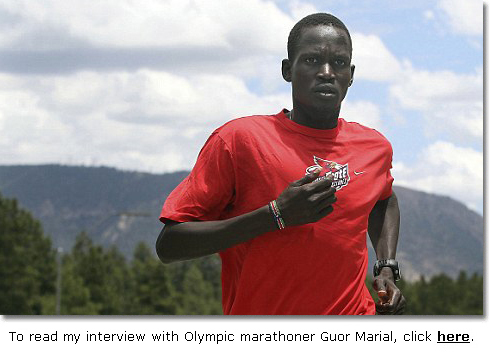
Guor Marial's life has been its own extraordinary marathon. When he was 15, he fled his native Sudan, a nation embroiled in a decades-long civil war that killed two million people, including eight of his brothers and sisters.
Granted asylum in the U.S., Marial moved to New Hampshire, where he became a high school track star, setting a national record with his two-mile time and earning a scholarship to Iowa State, where he won All-America honors. Now he is heading back across the Atlantic, to London, where he will run the marathon at the 2012 Olympic Games. Marial spoke with me about his remarkable journey: from Sudanese refugee to London Olympian.

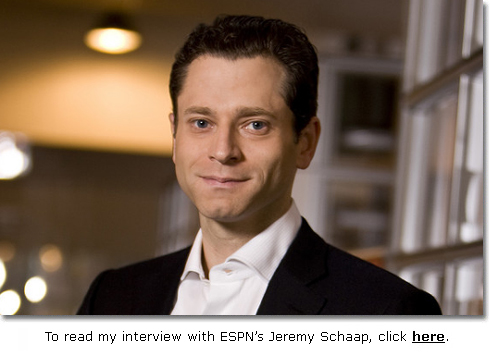
When the Penn State scandal broke, the cable channels quickly flooded with Joe Paterno apologists: commentators who spoke of the coach's legendary character, reporters who bathed their reports in weasel words like "wrongdoing" and "alleged misconduct."
Jeremy Schaap took a different route. The six-time Emmy Award-winning ESPN reporter has given graphic descriptions of the abuse suffered by Jerry Sandusky's victims and labeled Paterno "an accessory" to his assistant coach's crimes. While others have asked for the famous JoePa statue to stay standing, Schaap has called for it to be torn down and replaced with a statue dedicated to the abused boys who bravely stepped forward. Schaap spoke with me about his Penn State reporting and his efforts to give a voice to the victims.
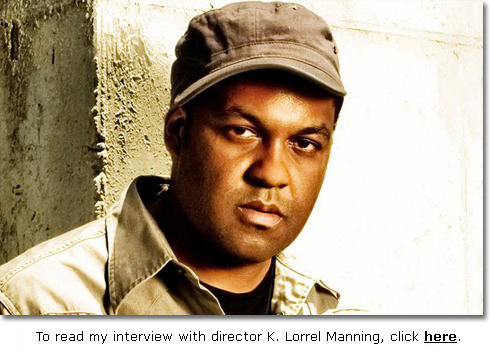
Most filmmakers shy away from tough topics and eschew sour endings, which makes director K. Lorrel Manning's "Happy New Year" a notable achievement.
Manning's film follows the struggles of a sergeant wounded in Iraq, now back in the States, trying to heal inside a bleak veterans' hospital. The film doesn't pull any punches in its depiction of PTSD, which proves as crippling to the sergeant as the injuries to his legs.
"New Year" was screened here in New York in mid-June, followed by a panel discussion featuring the director and the film's star, Michael Cuomo. Before the event, Manning spoke with me about the genesis of the film and his eye-opening discussions with wounded soldiers.
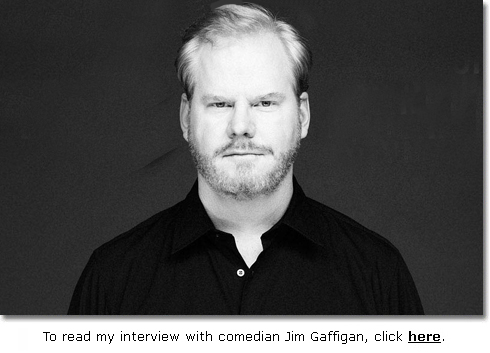
In November I attended a fundraiser for the Bob Woodruff Foundation, which assists wounded soldiers and their families. The lineup that night included Jim Gaffigan, a loveable comic with a dry wit and a famous obsession with Hot Pockets. He brought down the house with an extended bit about the shame that brews inside every person that eats at McDonald's.
Soon after Gaffigan released his eighth album, "Mr. Universe," and announced that a portion of the proceeds would go to the Woodruff Foundation. The comedian spoke with me about why he's reaching out to military families, why becoming famous has been both a blessing and a curse, and why his stand-up doesn't need swear words to hit home.
Days after an American soldier shot and killed 17 Afghan civilians, including four women and nine children, I was asked to speak about the tragedy on "The Marc Steiner Show." Steiner and I were joined by three veterans: Sergeant Chuck Luther, who served in Iraq and directs the soldiers advocacy group Disposable Warriors; Sergeant Graham Clumpner, who served in Afghanistan and is now an organizer for Iraq Veterans Against the War; and Woody Curry, who served in Vietnam and is now a director with the Baltimore Station, a non-profit that assists troubled vets.
What followed was a personal conversation unlike any I have ever heard on radio, each soldier sharing private, painful memories from their time at war.
The show also highlighted the Essential List of Veterans' Resources, which I compiled for the Huffington Post. I hope every military family downloads the list and takes advantage of those resources.



In February, five years after Part 1 in my series on fraudulent personality disorder discharges was released in The Nation, the New York Times explored the scandal on its front page. Reporter James Dao highlighted the story of Captain Susan Carlson, who served in Afghanistan and was then discharged with a pre-existing personality disorder.
Dao's reporting updated the PD statistics: The military has now discharged more than 31,000 soldiers with personality disorder, preventing them from collecting a lifetime of disability and medical benefits.
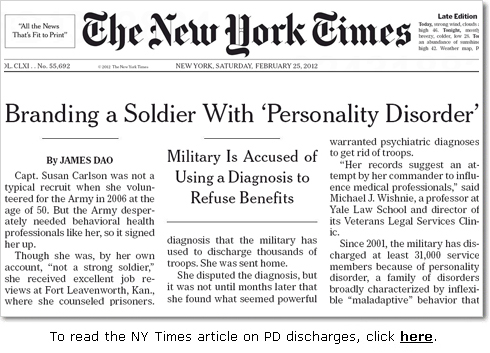
The Times' article scratched the surface of the larger scandal, leaving the stories of physically wounded soldiers who are being denied disability and medical benefits off the page. In response, I wrote a letter to the New York Times spotlighting some of the horrors I had uncovered in my six years of reporting on the fraudulent discharges. The letter, which ran a few days after the Times' front-page report, ended with a call to action.
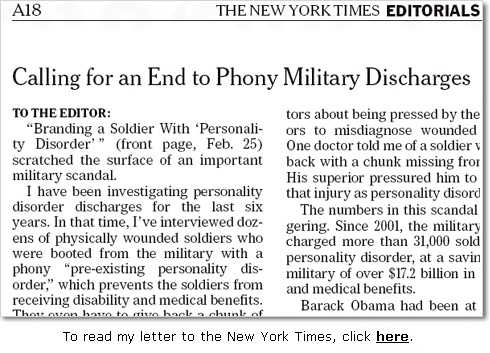

Few filmmakers have had as much impact as Joe Berlinger.
In 1993 the acclaimed director traveled to West Memphis, Arkansas, where he watched as three teens were falsely convicted of murder. Stunned and horrified, Berlinger made a commitment: he would investigate the crime and spotlight the teens' case until the injustice was reversed.
In 1996 Berlinger and co-director Bruce Sinofsky released "Paradise Lost: The Child Murders at Robin Hood Hills," followed in 2000 by "Paradise Lost: Revelations," sparking a wave of outrage and legal challenges that led to the young men being released from prison in August 2011. Berlinger's final film on the case—"Paradise Lost: Purgatory"—premieres this month on HBO and was just nominated for an Academy Award for Best Documentary. The director spoke with me about the widespread impact of the films and what the case has meant to him.
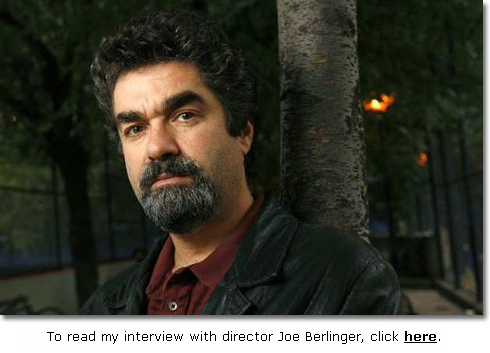
There's nothing like bonding with a Muppet. Recently I dropped by "Sesame Street" for a backstage chat with Murray Monster, one of the rising stars of the show.
Since 2005 the children's program has featured the adventures of the loveable monster, an oversized Elmo with an unrestrained enthusiasm and the shaggy fur of a neglected bath mat. An amateur reporter, Murray travels around New York City interviewing students about their passions for science and soccer, karate and Irish dance. Joining us for our Q&A was
Joey Mazzarino, voice of the beloved monster and head writer of the show.
To celebrate Veterans Day, I joined host Hugh Hamilton at WBAI's Manhattan studios. Hamilton has been one of New York's most popular radio hosts for more than a decade. His program, "Talk Back," features his extensive historical knowledge and hypnotic Guyanan accent.
Hamilton and I discussed the many ways in which we, as civilians, can give back to the soldiers who have served us — from visiting USATogether.org and assisting a military family, to donating to the Bob Woodruff Foundation, to making a promise that this year you'll get to know a soldier in your neighborhood and figure out how you can help him.
Hamilton highlighted the Essential List of Veterans' Resources, which I compiled for the Huffington Post. I hope every military family downloads the list and takes advantage of those resources.

In August actress Jessica Sherr emerged as one of New York theater's up-and-coming stars. Her one-woman show, "Bette Davis Ain't For Sissies," opened to enthusiastic reviews from critics and fans, bringing the actress newfound recognition. The show—written, directed and starring Sherr—traces Davis' Hollywood journey, from unknown newcomer to two-time Academy Award winner.
Sherr sat down and spoke with me about her own acting journey and how an off-hand comment about her bright green eyes sparked a burgeoning career as Davis' 21st century counterpart.

Photographer Lisa Kristine was stunned to learn a disturbing fact: that
148 years after the Emancipation Proclamation, slavery is still rampant, both in the U.S. and beyond. According to the non-profit organization
Free the Slaves, 27 million people are currently enslaved. Who are they? Kristine was determined to find out. She picked up her camera and traveled the world—from Ghana to India to Nepal—photographing slaves, recording their stories.
As part of my ongoing Huffington Post Q&A series, Kristine spoke with me about the people she met and the cruelty she witnessed.


This month I was honored to receive a reporting prize from the National Press Club. The NPC's Sandy Hume Memorial Award honors excellence and objectivity in political reporting. I won the prize for my coverage of Sgt. Luther and the torture scandal.
During the awards ceremony, I spoke about the torture scandal. And the Press Club played a brief video about my reporting.



In June I was named a finalist for the Molly National Journalism Prize. The Molly, as it's known, recognizes reporting in the spirit of renegade Texas columnist Molly Ivins, who died in 2007 following an extended battle with breast cancer. It was a tremendous honor, one that followed on the heels of two honors here in New York, from the NY chapter of the Society of Professional Journalists. For my reporting on Sgt. Chuck Luther and the torture scandal, I won the NY-SPJ's award for Best Investigative Reporting and was named a finalist for its Public Service Award.

She is one of radio's strongest voices. For more than two decades, on KPFK Los Angeles, Suzi Weissman has been leading a heated discussion about politics and the Pentagon, classic cinema and modern feminism. Weissman's show, "Beneath the Surface," airs up and down the West Coast via the Pacifica Radio Network. For Memorial Day, the host asked me to return to discuss a groundbreaking ruling by the Ninth Circuit Court of Appeals.
With thunderous language, the court declared that the Department of Veterans Affairs' health system is so inadequate, it violates veterans' constitutional rights. Weissman and I discussed what the ruling will mean for our soldiers and for the VA.

Sergeant Chuck Luther returned from Iraq in 2007. Since then, he has been reaching out to wounded soldiers. His non-profit organization, Disposable Warriors, has helped dozens of wounded veterans acquire disability and medical benefits.
On Memorial Day, Luther pushed his organization's mission one step further, reaching out to our soldiers' children. Disposable Warriors announced a $2,000 scholarship for the children of former and active-duty soldiers. Having reported on Luther's personal story, I was asked to help judge this year's entries. I gladly agreed.

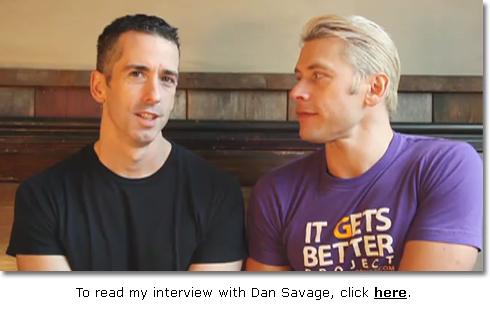
For years I've enjoyed Dan Savage's sex advice podcast, "Savage Love," an X-rated exploration of kinks, curiosities and dating wisdom. In September, Savage and his husband, Terry Miller, made national news following a string of suicides by gay youths. The two posted a video on YouTube encouraging gay youths to tough out their school years to reach the better life waiting for them after graduation.
Their video spurred thousands of prominent gay figures and straight leaders like President Obama to make encouraging videos of their own. Today Savage and Miller are co-founders of the It Gets Better Project, a non-profit organization designed to spread their video's message. As part of my Huffington Post Q&A series, I spoke with Savage about the project and the remarkable impact it has made.
I
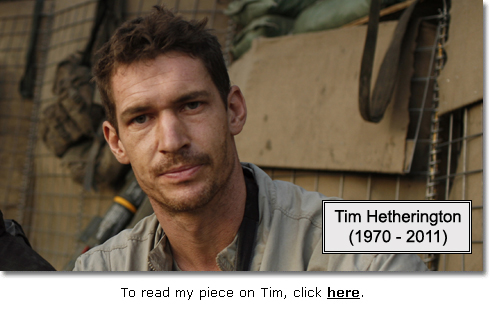
was stunned and saddened to learn that Tim Hetherington, acclaimed photographer and co-director of the Afghan war documentary "Restrepo," had died. Tim was killed Wednesday, April 20, in Misrata, Libya, while covering Gaddafi's attack on rebel forces.
I met Tim a few weeks earlier at the Columbia Journalism School, at a screening of "Restrepo," after which we began exchanging emails, with Tim showing support for my reporting. Following his death, I went back through those letters and wrote this memorial piece for the Huffington Post.
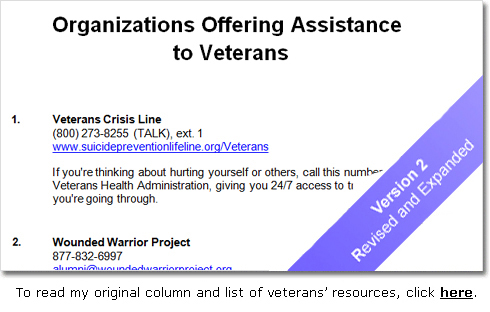
For years I've been getting calls from soldiers in crisis. Some have been wrongfully discharged and denied benefits. Others urgently need medical care. Each of them asks me: "Where do I go for help?"
In a new Huffington Post column, I set out to answer that question. I compiled a list of
27 resources for veterans in need. When I released the list, I received a flood of email, most naming additional organizations I had overlooked. I examined each of those organizations, then updated the list and produced a follow-up column highlighting some of the best programs.
If you're a vet, download this list and check out the organizations offering you help. If you know a military family, forward the list to them. Together we can make sure that awful question—where do I turn for help?—never plagues another soldier again.


Good news came early this spring as I was named a finalist for the Medill Medal for Courage in Journalism. The medal honors reporters who display "moral, ethical or physical courage in the pursuit of a story."
The prize is awarded by the Medill School of Journalism at Northwestern University, one of the most prestigious journalism programs in the country. I was selected as a finalist for my reporting on Sergeant Chuck Luther and the torture scandal.

In late February I returned home to San Francisco to speak at my high school's Career Day and spend some time with my family. I ended up at KGO, San Francisco's ABC News headquarters, speaking with host Peter B. Collins. Collins is a Bay Area institution, with over 30 years on the radio dial. He and I had done several interviews over the phone. This was our first in person.
With the
Academy Awards just hours away, we spoke about my interview series with Oscar nominees and my continued reporting on the personality disorder scandal and veterans' benefits.

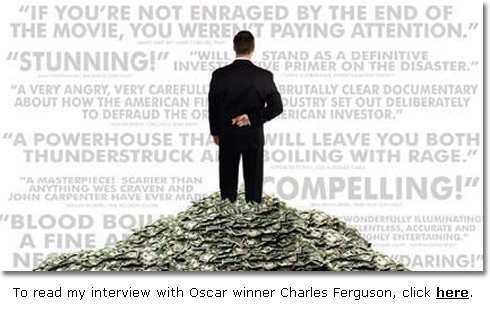
Charles Ferguson goes where others dare not travel. In 2007, when movies like "Lions for Lambs" and "Home of the Brave" were proving Iraq toxic at the box office, Ferguson released "No End in Sight," an engrossing examination of the Bush administration's post-invasion blunders. That film earned Ferguson an Oscar nomination for Best Documentary.
The director has now captured the Oscar with his second film, "Inside Job," an infuriating look at the cronyism that triggered the 2008 financial meltdown, which destroyed millions of jobs and torched trillions of dollars in worldwide capital.
Ferguson spoke with me about his new film and President Obama's disappointingly silent reaction to it.
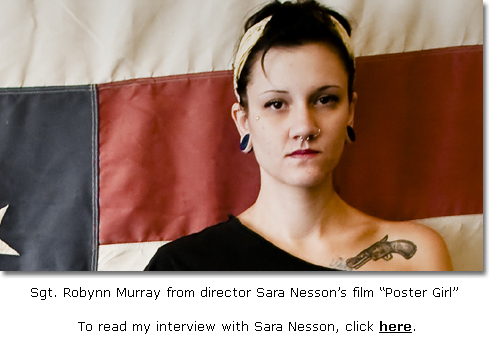
Director Sara Nesson set out to make a movie about a group of soldiers on Martha's Vineyard who were finding healing by cutting up their uniforms and turning them into art. After developing a bond with one of those soldiers, Sergeant Robynn Murray, Nesson shifted gears and decided instead to tell her story.
Murray had the credentials of the all-American girl: a cheerleader and National Merit Scholar who joined the Army soon after high school. Murray manned a machine gun in Iraq, then returned home a physical and emotional wreck. For two years Nesson followed her as she battled the Veterans' Administration for a doctor's appointment, fought off a collection agency and punched walls in PTSD-fueled frustration.
Nesson's film, "Poster Girl," has now been nominated for an Academy Award for Best Documentary (Short Subject).
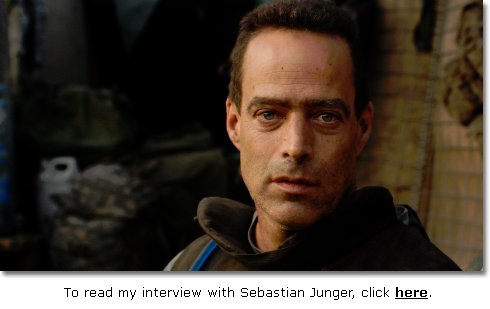
My interview series with Oscar-nominated filmmakers continues with Sebastian Junger, director of "Restrepo." Junger and co-director Tim Hetherington spent 14 months in Afghanistan's Korangal Valley, known as "the deadliest place on Earth." Their film follows the men of the 503rd Infantry Regiment as they push into enemy territory, set up a remote outpost and exchange fire with the Taliban. In the process, "Restrepo" gives a rare, soldier's-eye view of the Afghan conflict.
Junger and Hetherington's film won the Grand Jury Prize at the 2010 Sundance Film Festival and has now been nominated for an Academy Award for Best Documentary.

When
Current Science asked me to investigate natural gas drilling, immediately I turned to Josh Fox. Fox's documentary "Gasland" looks at the human cost of drilling for natural gas. The director travels to drill sites across the country, stopping at towns where the tap water is now tainted and the families are deeply ill.
Fox's film won the Special Jury Prize at Sundance, the Lennon-Ono Peace Prize, and now has been nominated for an Academy Award. I published our interview as part of my ongoing Q&A series for the Huffington Post.

On December 16 the Army Times delivered stunning news: the Vietnam Veterans of America (VVA), one of the most prominent veterans' groups in the country, is suing the Pentagon for its use of personality disorder discharges. The VVA is demanding that the Defense Department hand over its complete records on the 25,600 soldiers discharged for the pre-existing illness since 2001.
As reporter Kelly Kennedy explains,
the suit comes at a critical juncture, as discharges for pre-existing conditions like adjustment disorder have risen dramatically in recent years.
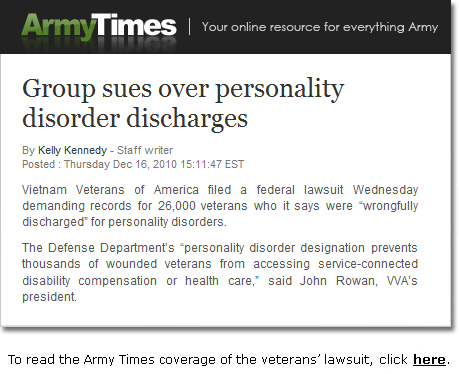
To bring their lawsuit against the Pentagon, the vets are partnering with Yale Law School's Veterans Legal Services Clinic.
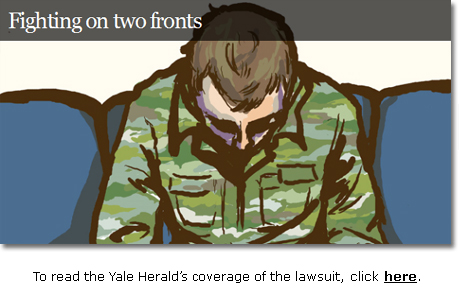
Yale Herald reporter Sarah Yager is following the case. In her recent article, "Fighting on Two Fronts," Yager gives the latest details on the lawsuit and updates the case of Sgt. Chuck Luther. Luther, who was pushed out of the military with personality disorder, has been asked to rejoin the Army and is now working at Fort Hood, providing counseling to soldiers who have "fallen through the cracks."
Inspired by my Q&A with comedian Adam Carolla, master of the irreverent complaint, I decided to take a stab at humor myself, posting two pieces to the Huffington Post's comedy section. In the first, I groused about my new iMac, complaining about its mouse, keyboard and screen resolution.
After I was flooded by angry letters from Mac lovers who took each of my complaints at face value, I wrote a follow-up, noting the difficulty of doing deadpan comedy in print and drawing attention to the true vitriol in the stack of emails.
 
In November I spoke with two of the great minds of our time: Dr. Drew Pinsky and comedian Adam Carolla. For over a decade the two
co-hosted "Loveline," the popular sex advice radio show, lighting up the airwaves with a crackling chemistry comatose shows like "Parker Spitzer" can only dream of.
Nowadays Carolla's snarky humor and off-handed wisdom are broadcast on "The Adam Carolla Show," iTunes' most-downloaded podcast, while Pinsky has pushed forward on the radio dial, entering his 26th year
behind the "Loveline" mike.
 When I posted video of the torture hearings on YouTube, it attracted thousands of viewers. Hoping to draw millions more, I sought advice from Time magazine's wise guy Joel Stein, who offered some sagacious advice on how to make a video go viral. When I posted video of the torture hearings on YouTube, it attracted thousands of viewers. Hoping to draw millions more, I sought advice from Time magazine's wise guy Joel Stein, who offered some sagacious advice on how to make a video go viral.
To read our interview, click here.
To watch the YouTube video, click here.
For more of my Huffington Post Q&A series,
click here.
Sgt. Chuck Luther's hell began in Iraq, where he was severely wounded by mortar fire. Army officials then placed Luther in a closet and held him there for over a month, under enforced sleep deprivation, until he agreed to sign papers saying his wounds were caused by a pre-existing condition, making him ineligible for benefits.
After I reported Luther's story in The Nation, Congress called him to Capitol Hill to detail his treatment.




On Veterans Day I appeared on "GRITtv," a news talk program on the Manhattan Neighborhood Network (MNN), to discuss the recent torture hearings.
The show, hosted by Laura Flanders, also included commentary from Margaret Stevens, a veteran of the New Jersey National Guard and professor of history at Essex County College, who spoke about the challenges facing female soldiers.

It was my second appearance on "GRITtv." On Memorial Day Flanders invited me to discuss PTSD and veterans' suicides. That show featured video and commentary from Dan Lohaus, whose documentary about homeless Iraq vets, "When I Came Home," was honored at the Tribeca Film Festival.
Also featured in the clip is Iraq vet Darren Subarton, who talks about his struggles with PTSD. On Dec. 27, 2009, Subarton was found dead at his parents' house in Pennsylvania. He leaves behind a wife and young son.

Recently ABC News Radio, San Francisco (KGO) invited me to discuss Sgt. Luther's torture. The host, Ronn Owens, drew strong reactions from listeners, as he played clips from the Congressional hearings sparked by my reporting. It was my second appearance on Owens' program. In May the host invited me to discuss the personality disorder scandal and Iraq and Afghanistan soldiers' struggle for benefits.
On Veterans Day, I appeared on Owens' show again to talk about the newly released video of the torture hearings and discuss what all of us can do to honor our soldiers.



 Responding my appearance on Ronn Owens' show, Examiner columnist Brad Kava wrote with passion about the personality disorder scandal. "This is the most important story of our time," he wrote, "and it has gotten barely any coverage." Responding my appearance on Ronn Owens' show, Examiner columnist Brad Kava wrote with passion about the personality disorder scandal. "This is the most important story of our time," he wrote, "and it has gotten barely any coverage."
In 2007 I began reporting for Current Science, a popular children's science magazine. Since then, I've covered everything from global warming and volcanoes to paraplegic scuba diving and the art of creating perfume.

 Ilan Stavans, my mentor and friend, has been producing a steady stream of books, 48 since 1993. His latest is his magnum opus: the 2,600-page "Norton Anthology of Latino Literature." Ilan Stavans, my mentor and friend, has been producing a steady stream of books, 48 since 1993. His latest is his magnum opus: the 2,600-page "Norton Anthology of Latino Literature."
As part of my ongoing Huffington Post Q&A series, Stavans and I reconnected to talk about the anthology, his family and his take on Latino culture.
To read the interview, click here.
To check out the entire Q&A series, click here.
In April The Nation ran my article on how the U.S. Army tortured Sgt. Chuck Luther. A few months later Congress launched its own investigation. On September 15 the House Committee on Veterans' Affairs held hearings on Luther's case. I was called to testify, as was Sgt. Luther and a panel of high-ranking Army officials.
The explosive hearings received international attention, including this piece from RT Television.

|
Following the hearings, I appeared on the popular San Francisco radio program "Wake Up, Everybody." Host Donald Lacy and I discussed the dramatic twists of the Congressional hearing, including Sgt. Luther's graphic account of his own torture and Congressman Steve Buyer's storming out of the room in the middle of Luther's testimony.

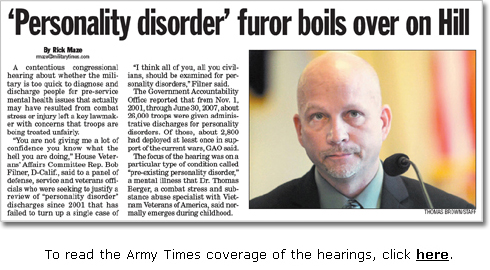
Washington's newspapers picked up on the torture hearings as well. The Hill and Army Times focused on the fraudulent "personality disorder" discharge given to Sgt. Luther. The military has used that pre-existing condition to discharge and deny benefits to thousands of wounded soldiers. And as Times reporter Rick Maze notes, new data shows that the military is increasingly using a second pre-existing condition, "adjustment disorder," to dismiss thousands more.
 

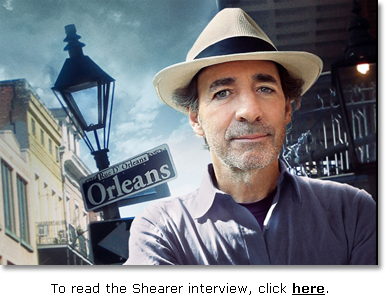
Continuing my Huffington Post Q&A series, I interviewed a real hero of mine: actor, author and "Simpsons" voice-over artist Harry Shearer, better known to the world as Ned Flanders, Mr. Burns, Mr. Smithers, Reverend Lovejoy and Kang the Alien Octopus. Shearer spoke with me about his new documentary, "The Big Uneasy," a serious, scientific look at why New Orleans flooded.
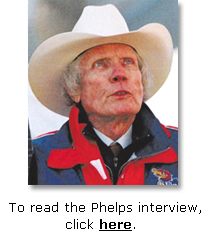
In August, as part of my Huffington Post Q&A series, I interviewed Pastor Fred Phelps, the most virulent anti-homosexual activist in the nation. The pastor and his Topeka, Kansas, congregation travel the country picketing the funerals of soldiers who died in Iraq and Afghanistan. Those soldiers, says Phelps, died defending a nation that accepts the "evils of homosexuality." In October, Phelps will defend himself before the Supreme Court, which will consider whether his graveside picketing is constitutionally protected free speech.
The next day I interviewed Dustin Lance Black, Oscar-winning screenwriter of "Milk" and one of the nation's foremost gay rights advocates. Black travels the country speaking to youths about Prop 8, "Don't Ask, Don't Tell" and the unique challenges of growing up gay in America.
Over 230,000 women have served in Iraq and Afghanistan, but few of their stories have been told. Laura Browder and Sascha Pflaeging sought to change that. Their new book, "When Janey Comes Marching Home," provides an uncensored look at our female soldiers. In this Huffington Post Q&A, I spoke with Browder about the unique challenges of being a woman in uniform.

I just revamped my Facebook and Twitter pages. Join me for updates on my military reporting, breaking news stories and info on upcoming radio and TV appearances.
 
On July 10 President Obama announced a major change in the military's approach to PTSD. Traumatized soldiers had been required to gather witnesses and documentation to prove their PTSD came from war. Now, announced Obama, soldiers with PTSD would no longer need to prove their case to collect benefits.
The BBC
invited me on their flagship radio program, "Newshour," to discuss the development with host Lyse Doucet and behavioral scientist Terry Schell of the RAND Corporation, who produced a groundbreaking report on PTSD.

 Just before Independence Day General Petraeus vowed to Congress to protect soldiers. Days earlier the Army denied Sgt. Luther's appeal for a medical discharge. In my third Huffington piece, I look at Petraeus' vow in light of that denial. Just before Independence Day General Petraeus vowed to Congress to protect soldiers. Days earlier the Army denied Sgt. Luther's appeal for a medical discharge. In my third Huffington piece, I look at Petraeus' vow in light of that denial.
To read the post, click here.
To read all my Huffington posts, click here.
For Memorial Day, I appeared on Sirius XM to discuss the personality disorder scandal with Bob Edwards. Edwards, a Peabody Award-winning journalist and one of satellite radio's most respected hosts, was perturbed to hear how the military was disrespecting its soldiers on a day meant to honor them.

 On Memorial Day I also released my second Huffington piece: "Facebook Members Rally around Tortured American Soldier." On Memorial Day I also released my second Huffington piece: "Facebook Members Rally around Tortured American Soldier."
To read the post, click here.
To check out the Facebook page, click here.
Sgt. Chuck Luther and I appeared on two of the nation's top radio shows: BBC's "Here and Now," hosted by Robin Young, and WEAA's
"Marc Steiner Show."
 


 I'm now blogging about veterans' issues for the Huffington Post. My first post, "When the Army I'm now blogging about veterans' issues for the Huffington Post. My first post, "When the Army
Uses 'Enhanced Interrogation' on an American Soldier," is drawing hundreds of comments.
To read the post, click here.
To keep up on all my blog posts, click here.
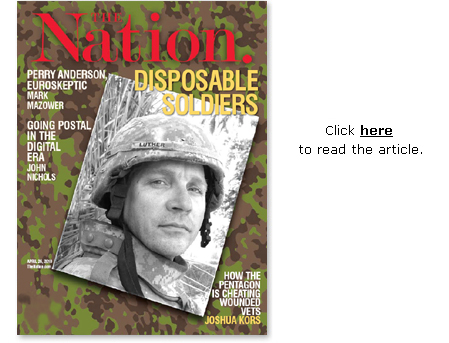
At last, after two years of reporting, I have completed Part 3 in my series on the Personality Disorder scandal.
The article will be the cover story in The Nation, April 26. It tells the story of Sgt. Chuck Luther, who was wounded by mortar fire in Iraq, then held captive in a U.S. Army aid station for over a month, under enforced sleep deprivation, until he agreed to sign fraudulent papers saying his wounds came from a pre-existing personality disorder.
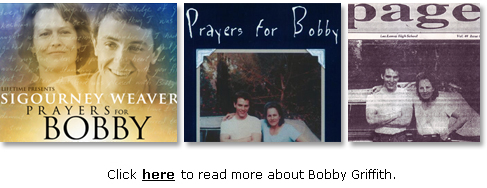
In 1983 Bobby Griffith, a gay student from my hometown, committed suicide. In the wake of his death, Griffith's mother, an ardent opponent of homosexuality, became one of the nation's leading gay activists.
In 1995, as a junior in high school, I told the Griffiths' story in an article for the school paper. Soon after it became a book. And this year it was made into an Emmy-nominated movie starring Sigourney Weaver. To celebrate the nomination, I've posted my original article, along with information about the book, film and Bobby's life.
|